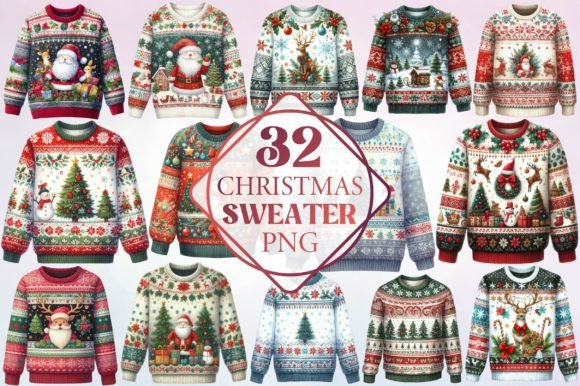
Watercolor Christmas Sweater Clipart Review
As a designer who spends half my day staring at stitch charts and the other half troubleshooting tension issues on vintage machines, I don’t just buy digital assets; I stress-test them. When I came across Watercolor Christmas Sweater Clipart, my first instinct wasn’t to add it to my cart immediately. It was to ask: how will this translate from a soft, digital illustration into a tangible, stitched reality? Embroidery is a medium of texture and thread, not pixels. A design that looks beautiful on a screen can often fall flat or become a tangled mess on fabric if the underlying structure isn't sound.
I decided to put this Illustrations category asset through its paces. The goal was to determine if this machine embroidery design could hold up in a real-world commercial setting, specifically for a small batch of holiday merchandise. Below is my practical breakdown of how Watercolor Christmas Sweater Clipart performs when moving from file to finished product.
The First Impression: Mood and Visual Personality
When you open the file, the immediate takeaway is the artistic intent. Unlike traditional vector clipart which relies on hard lines and solid blocks of color, this design embraces a softer, more organic aesthetic. The "watercolor" effect suggests bleeding edges and gradient-like transitions, which creates a cozy, nostalgic mood perfect for the winter season. It feels less like a rigid logo and more like a hand-painted greeting card.
For an embroidery project, this translates to a design that feels approachable and warm. It avoids the harshness of high-contrast geometric shapes, making it ideal for handmade product lines that target families, nurseries, or boutique gift shops. The visual personality here is gentle. It doesn’t shout; it invites. This is crucial for items like baby clothes or delicate tea towels where a bold, aggressive graphic might feel out of place. However, as any seasoned embroiderer knows, "soft" can sometimes mean "lacking definition." The challenge lies in ensuring that the subtle details of the watercolor style remain distinct once converted into thread.
Real-World Application: From Screen to Stitch
To truly evaluate Watercolor Christmas Sweater Clipart, I simulated its use in three common scenarios: a custom embroidered tote bag, a sweatshirt chest print, and a personalized baby onesie. Each of these applications demands different technical considerations.
Custom Apparel and Sweatshirts
When applying this design to a sweatshirt embroidery project, the watercolor aesthetic shines. The slight irregularity of the shapes mimics the texture of knit fabric, creating a harmonious blend between the art and the garment. On a heavy cotton or fleece sweatshirt, the fill stitch areas provide enough coverage to anchor the design without feeling bulky. Customers looking for custom apparel often seek items that look artisanal rather than mass-produced. This design delivers that boutique feel. It works particularly well as a chest-sized accent or a larger back print where the intricate details have room to breathe.
Tote Bags and Accessories
A tote bag design requires durability and visibility. Here, the contrast becomes key. If you are stitching this onto a natural canvas bag, the lighter threads used to simulate watercolor highlights may get lost. However, on a darker background or with high-contrast thread choices, the design pops beautifully. It adds a touch of elegance to what is otherwise a utilitarian item. For Etsy sellers and craft business owners, this versatility is a major selling point. A single design can be marketed as a holiday market accessory, a reusable shopping bag, or a gift wrap alternative.
Baby Items and Nursery Decor
This is perhaps the strongest use case. The soft, muted tones inherent in a watercolor style are inherently soothing. When adapted for baby embroidery—such as on muslin blankets, hooded towels, or bibs—the design exudes tenderness. It avoids the cliché of bright, primary-colored Santa figures, offering instead a sophisticated, modern take on holiday themes. Parents today are increasingly drawn to nursery decor that aligns with contemporary interior design trends, and this clipart fits seamlessly into that aesthetic.
Technical Considerations and Potential Pitfalls
No design is perfect, and understanding the limitations of Watercolor Christmas Sweater Clipart is just as important as praising its strengths. Embroidery is a subtractive and additive process that alters the physical properties of fabric. Here is where you need to be careful.
- Small Hoop Sizes: Avoid placing this design in very small hoops (under 4x4 inches). The watercolor style relies on subtle variations in tone and shape. If scaled down too much, these nuances disappear, leaving behind muddy blobs of thread. Always check the minimum recommended size before finalizing your layout.
- Textured and Stretchy Fabrics: While the design looks great on stable knits, applying it to highly textured fabrics like bouclé or thin, stretchy jersey can distort the delicate lines. The fabric’s natural movement can cause the stitch density to pucker or shift. Use a proper stabilizer—preferably cut-away for stretchy materials—to mitigate this risk.
- Dense Stitch Areas: Watercolor effects often require dense fills to cover the base fabric completely. Ensure your machine can handle the specified stitch density. Overly dense designs on lightweight fabrics can create stiff, uncomfortable patches that detract from the finished product’s wearability.
- Thread Color Contrast: Since the original image is likely digital with gradients, you must manually select appropriate thread colors during digitizing. Relying on automatic color mapping often results in clashing hues. Test your thread palette against the actual fabric swatch. A light gray thread on a white shirt will vanish, whereas a cream thread might offer just enough contrast to define the shape.
Design Assets for Commercial Success
For commercial embroidery and digital product sellers, the value of Watercolor Christmas Sweater Clipart extends beyond a single stitch-out. Its aesthetic lends itself well to printable mockups and digital previews. Because the source is an illustration, it can be easily integrated into marketing materials, social media posts, and online store listings. It helps establish brand consistency for shops focusing on handmade, holiday-themed goods.
Furthermore, its adaptability allows for creative variations. You can combine it with satin stitch borders, add complementary running stitch elements, or layer it with applique techniques to create unique embroidered patch designs. This flexibility increases the perceived value of your offerings, allowing you to charge premium prices for personalized gifts and small shop products.
Final Verdict: Is It Worth the Investment?
In conclusion, Watercolor Christmas Sweater Clipart is a strong contender for designers looking to add a touch of elegance and warmth to their holiday collections. It succeeds in bridging the gap between digital artistry and tactile craftsmanship. However, success depends entirely on execution. You must respect the technical constraints of embroidery by testing on scrap fabric, verifying hoop size compatibility, and choosing high-quality threads.
If you are an Etsy seller, a creative entrepreneur, or a hobbyist looking to elevate your embroidery project game, this design offers a reliable foundation. Just remember: always inspect small details, confirm licensing terms for commercial use, and never skip the black-and-white mockup test. When done right, the result is not just a stitched image, but a cherished personalized gift that captures the spirit of the season.